
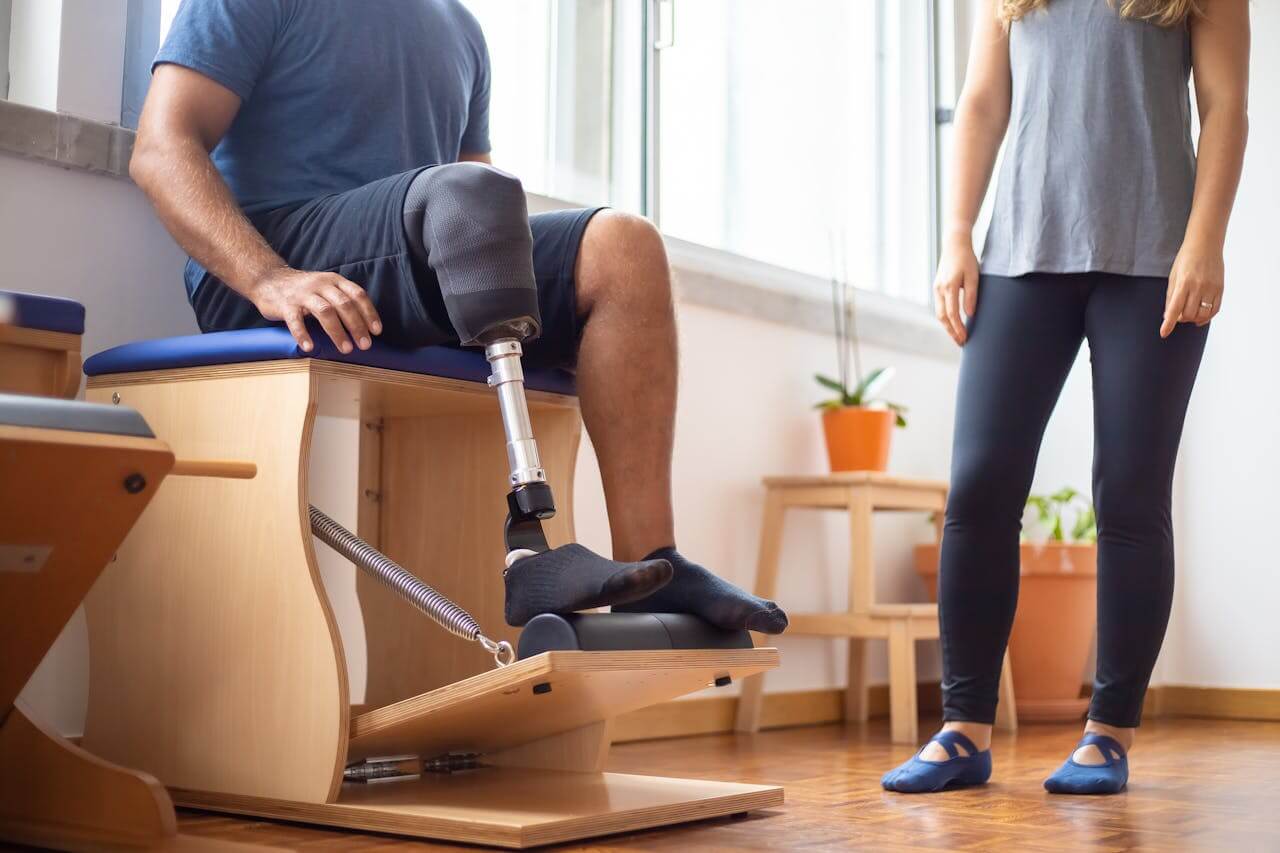
When was the last time you thought about the foot on the end of your prosthesis rather than the socket above it? Most wearers focus almost entirely on fit, which makes sense — a socket that hurts demands attention. But the foot determines a surprising amount of how walking feels: how much effort each step takes, how stable you are on a slope, whether you feel a slight push forward or nothing at all. If you’ve been on the same foot since your first device and your life has changed since then, the component may simply not match how you move anymore. Understanding the categories and what each is built to do makes that a much easier conversation to have with your prosthetist.
Categories of Prosthetic Feet and What Each Is Built For
Prosthetic feet fall into rough categories, and each represents a different set of tradeoffs.
At the simplest end sits the solid ankle cushion heel design. It has no moving parts. A cushioned heel compresses at heel strike, and a rigid keel provides a stable surface through the rest of the step. It’s durable, low maintenance, and light on cost. It’s also unforgiving on uneven ground, since it can’t adapt.
Single-axis feet add a hinge at the ankle allowing the foot to move up and down. That helps the foot reach the ground quickly, which improves stability early in stance — useful for wearers who need help feeling secure. The tradeoff is added parts and maintenance.
Multi-axial feet move in more than one plane, allowing some side-to-side and rotational motion. That helps considerably on uneven terrain, gravel, grass, and slopes.
Energy-storing feet, sometimes called dynamic response feet, use flexible carbon fiber or composite keels that deflect under load and return that energy as you push off. They make walking feel more responsive and reduce effort for wearers who are moving at any real pace.
Hydraulic and powered ankles sit at the more advanced end. Hydraulic ankles adjust resistance to adapt to slopes and stairs. Powered designs actively assist push-off. Both add capability, weight, cost, and maintenance requirements.
Split-toe and flexible keel variants add another layer, allowing the forefoot to conform independently on uneven ground rather than acting as one rigid plate.
Most feet combine features rather than fitting neatly into one box, and the categories are better understood as a vocabulary than as a menu.
Matching Foot Selection to Terrain, Work, and Daily Routine
The right foot follows from your actual day, not from a category ranking.
Start with terrain. Somebody who walks primarily on carpet, tile, and level sidewalks has different needs than somebody crossing gravel driveways, lawns, docks, or sand. Multi-axial and hydraulic designs earn their keep on variable ground, while a wearer on level surfaces may notice little benefit from either.
Consider your work. Standing all day on concrete asks something different than a job that has you climbing in and out of a truck, on ladders, or covering long distances. Weight matters when you’re wearing something twelve hours. Durability matters when the environment is rough. If your work involves water, dust, or chemicals, say so directly, because that eliminates certain components.
Think about pace and distance. Energy-storing designs make a larger difference for wearers walking with purpose over distance than for wearers making short trips around a house.
Factor in your weight and activity level, which affect the stiffness category your foot needs. A keel that’s too stiff feels dead. Too soft and it feels unstable. Your prosthetist selects this deliberately.
Height and footwear matter more than people expect. Feet are built for a specific heel height, and changing shoe style can alter your alignment. If you wear boots for work and something flatter otherwise, mention it — some feet accommodate a range, others don’t.
Finally, be honest about what you’ve stopped doing. That’s often where the real answer is hiding.
FAQ
What is the difference between an energy-storing foot and a solid ankle foot?
A solid ankle cushion heel foot has no moving parts — a cushioned heel absorbs impact and a rigid keel provides a stable platform. It’s simple, durable, and inexpensive, but it can’t adapt or give anything back. An energy-storing foot uses a flexible carbon fiber or composite keel that deflects under your weight and releases that energy as you push off, which many wearers describe as making walking feel more responsive and less effortful. The tradeoff is generally cost and, depending on design, durability in rough conditions.
Can I have more than one prosthetic foot for different activities?
It’s technically possible and some wearers do it, particularly for water activities or specific sports where an everyday foot isn’t suitable. The obstacle is usually coverage. Most insurers approve one device to meet your medical needs, and a second foot for recreation is often considered outside that. Approval is more likely when there’s a documented functional or medical reason rather than a preference. Talk to your prosthetist about what your specific plan has approved in similar situations before you count on it.
How long should an everyday prosthetic foot last?
Someone walking long distances daily on rough ground will wear a foot out faster than someone making short trips indoors. Watch for signs: visible cracks, delamination in a carbon keel, a heel that’s compressed and no longer rebounds, unusual noises, or a change in how walking feels. Have components inspected at routine visits rather than waiting for a failure.
The Right Foot Is Different For Everyone
Bring specifics about where you walk and what’s become difficult. OP Centers fits and adjusts componentry for patients across Florida, North Carolina, and South Carolina, and the evaluation starts with how you actually spend your day.