
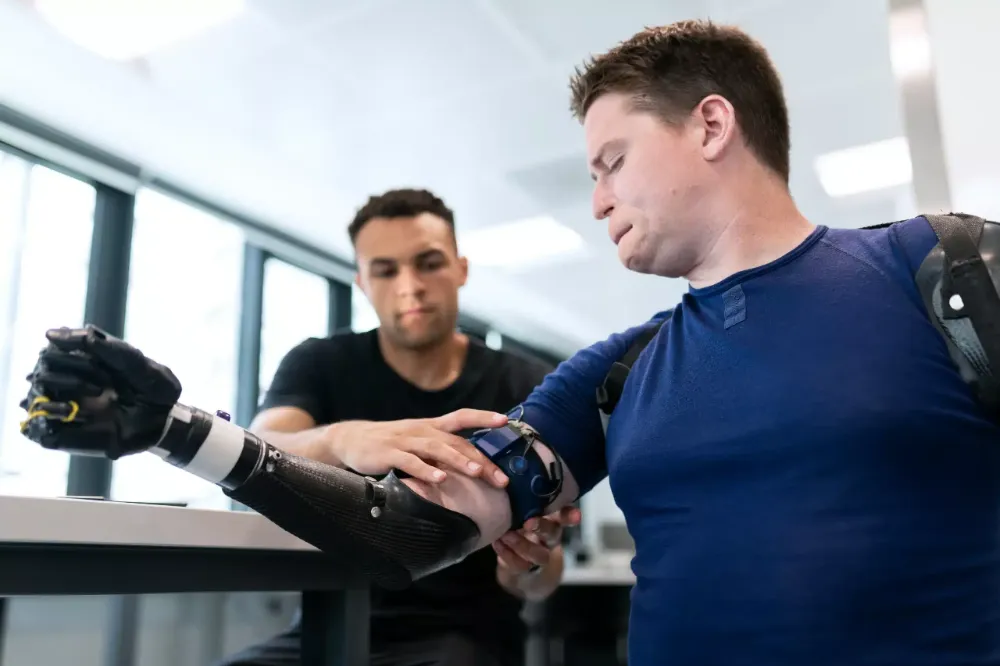
Have you ever felt your missing foot itch and wondered whether you should mention it to anyone? Almost every amputee experiences something like this, and almost every amputee spends some period assuming they’re the exception. They aren’t. Sensations from a limb that’s no longer there are among the most common experiences after amputation, and for a meaningful number of people those sensations are painful rather than merely strange. The subject gets less airtime than it deserves, partly because it sounds unsettling to describe and partly because people worry about how it’ll be received. It’s worth talking about plainly, because some of the most effective things that help are practical, available, and routinely overlooked.
The Difference Between Phantom Sensation and Phantom Pain
These two get lumped together constantly, and separating them is genuinely useful.
Phantom sensation is the experience of the missing limb still being present without pain attached. People describe feeling their foot, sensing toes they can almost wiggle, feeling the limb in a particular position, or noticing itching, tingling, warmth, or pressure. It’s extremely common after amputation and, for many people, simply becomes background over time. Some describe telescoping, where the phantom foot or hand feels closer to the residual limb than it should.
Phantom pain is different in character. It’s painful sensation perceived in the missing limb — often described as burning, shooting, stabbing, cramping, electrical, or a sense that the absent foot is twisted into an impossible position. Intensity ranges enormously between people and within the same person over time.
There’s a third category that gets confused with both: residual limb pain, meaning pain in the limb that’s actually there. That’s a separate problem with separate causes, including nerve issues, bone spurs, circulation, wound healing, and socket pressure. Distinguishing it from phantom pain matters, because the treatments diverge.
Knowing which one you’re dealing with helps your care team enormously. Pain in the missing foot and pain at the end of your residual limb point in very different directions, even when they feel connected.
Current understanding places phantom pain in how the nervous system and brain process signals after amputation, not in the limb itself. That’s important for one reason above all: the pain is real. It isn’t imagined, and it isn’t a psychological failing.
Approaches Patients and Clinicians Use to Manage Symptoms
There’s no single treatment that resolves phantom pain for everyone, which is frustrating but honest. What exists is a range of approaches, and many people find relief through some combination rather than one answer.
Medication is managed by your physician. Several drug categories are used, including some developed for nerve-related pain rather than conventional pain relief. What works varies considerably between individuals, and finding the right approach often takes adjustment over time.
Mirror therapy is widely used and costs almost nothing. It involves positioning a mirror so the reflection of the intact limb appears where the missing one would be, then performing movements while watching. Many people report reduced symptoms, and the approach has enough clinical support to be worth trying with guidance from your therapist.
Desensitization work — massage, tapping, varied textures against the residual limb — is a standard part of early rehabilitation and continues to help some people long afterward.
Physical activity and prosthesis use matter. Many wearers notice symptoms are less intrusive when they’re active and loading the limb.
Other approaches people pursue include TENS units, acupuncture, relaxation and mindfulness practices, and graded motor imagery. For persistent, severe pain, physicians may refer to a pain management specialist for interventional options.
Sleep and stress deserve mention. Many people find symptoms flare when they’re exhausted or under strain, and addressing those isn’t a soft substitute for treatment — it’s part of it.
Track what happens. A simple log of timing, triggers, and intensity gives your care team something concrete to work from instead of impressions.
When Socket Fit Is the Hidden Cause of Discomfort
Here’s the part that gets missed most often, and it sits squarely in your prosthetist’s territory.
A poorly fitting socket creates persistent pressure, friction, and abnormal loading on the residual limb — including on nerve tissue. That input can aggravate phantom symptoms or produce residual limb pain that gets attributed to phantom pain by default. Wearers spend months on medication adjustments for a problem that a socket modification would have addressed.
The pattern to watch for is timing. If your symptoms are noticeably worse while wearing the prosthesis and settle after you doff, or if they’ve increased since your limb changed volume, fit is a prime suspect. Same if pain arrives alongside new skin marks, redness over bony areas, or a sensation of movement inside the socket.
Volume change is the usual mechanism. As your limb shrinks, the socket stops distributing load the way it was designed to, and pressure concentrates where it shouldn’t — sometimes directly over a nerve.
Alignment plays a role too. A prosthesis that isn’t aligned well changes how force travels through the limb with every step.
None of this means socket fit explains all phantom pain. Plenty of people have significant symptoms with an excellent-fitting socket. But it’s cheap to rule out and frequently overlooked, so it belongs early in the conversation rather than at the end of it.
Describe the pattern to your prosthetist specifically: when it happens, where, and what you were doing.
FAQ
How long does phantom limb pain usually last?
There’s no reliable timeline, and anyone offering a firm one is guessing. Many people find symptoms are most intense in the months following surgery and gradually become less frequent and less severe over the first year or two. Others experience symptoms that persist far longer or come and go for years, sometimes triggered by weather, stress, illness, or fatigue. Persistence isn’t a sign that something’s wrong with you or that you’ve missed a window for help — treatment remains worth pursuing at any stage.
Can wearing my prosthesis more often reduce phantom pain?
Many wearers report that regular prosthesis use and staying active correspond with less intrusive symptoms, and sensory input from a well-fitting socket may play a role in that. It’s a reasonable thing to discuss with your care team. The important qualifier is that this only holds when the socket fits properly. Pushing through wear time in a poorly fitting socket tends to make things worse rather than better, and pain that increases with wear is a reason to be seen.
Should I tell my prosthetist about phantom sensations or only my doctor?
Tell both. Your physician manages medical treatment, but your prosthetist is the person who can identify whether socket fit, pressure, or alignment is contributing — and that’s one of the most commonly missed causes. Prosthetists hear about phantom symptoms constantly and won’t find it strange or alarming. Be specific about when it happens, whether it’s better or worse in the prosthesis, and what’s changed recently. That detail is what turns a vague complaint into something actionable.
Talking Openly About Pain Gets You Better Answers
Silence is the main thing standing between people and relief here. Amputees minimize these symptoms because they sound odd, because they don’t want to seem like they’re complaining, or because someone once implied it was in their head. It isn’t, and downplaying it only limits what your care team can do. Describe what you feel, when it happens, and what makes it worse — plainly and in detail. OPC Centers works with patients across Florida, North Carolina, and South Carolina on the part of this that’s within reach: a socket that fits and doesn’t quietly make things harder.